
Book a free 30-minute consultation
Let’s take a look under the hood of your website.
We’ll discuss your current website’s loading speed, the problems you’re experiencing, and whether a technical performance audit makes sense for you.
If your website is slow, we’ll help you understand why – and what it will take to fix it.
We Practice What We Preach
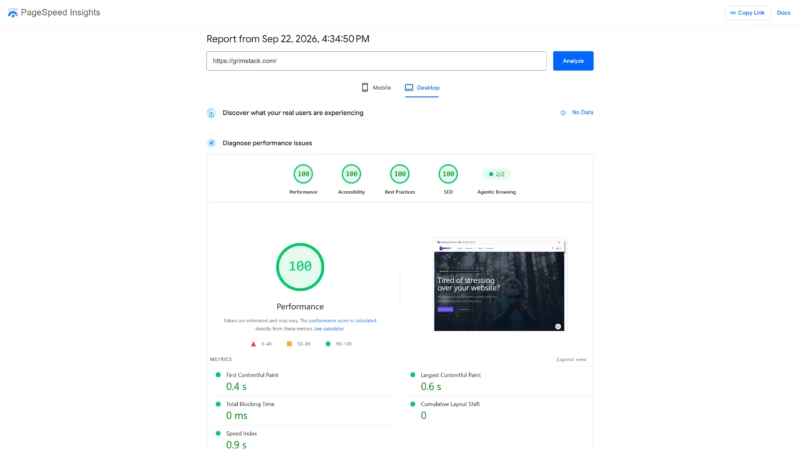
This website scores 100/100 on Google PageSpeed
The very site you are on is proof of what we preach.
Grimstack.com is built on WordPress and has been optimized for fast loading, efficient asset delivery, and strong Core Web Vitals.
But we don’t optimize websites to chase a perfect score.
The goal is to understand what makes a website slow – and fix the underlying problems based on your budget and other limitations.
We can test it, identify bottlenecks, and give you a clear plan for fixing them.
We Don't Just Test. We Diagnose.
Professional tools. Real diagnostics. Actionable fixes.
A speed test is a starting point – not a diagnosis.
We use industry-standard performance testing and WordPress-specific diagnostic tools to understand what is actually happening on your website.
A single tool can’t find all issues. Different tools help reveal different problems.
We combine their findings with hands-on WordPress investigation to separate symptoms from root causes.





What Do We Test?
A Technical Deep Dive Into Your WordPress Website
We don’t just run one speed test and send you a result screenshot.
We investigate your website from multiple angles to identify the actual bottlenecks.
What do we look for?
Page Speed & Core Web Vitals
We measure the metrics that matter for real-world website performance.
- Core Web Vitals
- Largest Contentful Paint (LCP)
- Interaction to Next Paint (INP)
- Cumulative Layout Shift (CLS)
- Time to First Byte (TTFB)
- Mobile & desktop performance
WordPress Performance
We investigate how WordPress itself is contributing to slowdowns.
- Plugin performance
- Theme and page-builder overhead
- Database queries
- Unnecessary scripts and styles
- PHP and WordPress configuration
- Plugin conflicts and bottlenecks
Front-End Performance
We look at everything the browser loads, renders, and delivers to your users.
- JavaScript and CSS code
- Images and media files
- Fonts
- Third-party scripts
- Render-blocking resources
Server & Caching
Sometimes the problem isn't your page – it's your hosting, CDN, or database.
- Hosting configuration
- Page and object caching
- CDN configuration
- Compression
- Database performance
WooCommerce Performance
For online stores, we investigate additional processes that can slow down your site: cart, checkout, and payments.
- Cart and checkout performance
- Product and shop pages
- WooCommerce queries
What Does a Faster Website Actually Give You?
Less waiting. Less technical overhead. A better website.
The goal of optimization isn’t to reach a certain score in a testing tool.
The goal is to optimize your website’s performance under heavy traffic, tailored to your budget, server capabilities, and other factors.
- Faster Page Loads
- Pages, images, scripts, and content load efficiently, reducing unnecessary waiting for visitors.
- Better Responsiveness
- A well-optimized website responds quickly when visitors click, scroll, open menus, submit forms, or interact with your store.
- Better Core Web Vitals
- We identify and address the technical problems behind metrics such as LCP, INP, and CLS.
- Less Technical Bloat
- We identify unnecessary plugins, scripts, styles, requests, and other sources of performance overhead.
- More Reliable WordPress
- Performance issues arise from plugin conflicts, inefficient queries, poor configuration, or overloaded infrastructure. Identifying these problems can make your website more stable and faster.
- A Cleaner Technical Setup
- Instead of continually adding another optimization plugin or workaround, we focus on understanding the underlying problem and fixing it properly.
A Clear Roadmap to a Faster Website
Technical Performance Audit
You receive a practical action plan – not just a score.
We’ll show you: What’s slow? → Why is it slow? → How should it be fixed?
Technical Performance Audit
€500 /per audit
Before changing plugins, installing another caching system, or rewriting code, we find out what is actually slowing your website down.
Comprehensive website performance inspection
Identification of performance bottlenecks
Prioritized list of recommended fixes
Explanation of what is causing each issue
30-minute consultation to review the findings
On-demand Optimization
€35 /hour
Once we know what’s slowing your website down, we can implement fixes.
You choose how much work you want us to handle.
Implementing recommended fixes
Fixing unexpected errors and conflicts
On-demand consultations
Our Terms of Service govern pricing and offers.
Our workflow
From a Slow Website to Measurable Improvements
Test & Diagnose
We test your website across desktop and mobile and collect performance data from multiple diagnostic tools. We investigate the underlying causes for your problems instead of simply treating the symptoms.
Prioritize & Fix
Rather than overwhelming you with a laundry list of changes, we help you identify, prioritize, and implement the improvements that matter most.
Test Again
After optimization, we test again to verify that the changes actually improved performance.
FAQ
Frequently asked questions
A WordPress speed audit is a technical investigation into why your website is slow.
We look beyond the score from tools like Google PageSpeed Insights and investigate WordPress, plugins, themes, JavaScript, CSS, images, database queries, caching, hosting, and other factors that can affect performance.
The result is a prioritized list of problems and recommended fixes.
No.
PageSpeed Insights is an excellent testing tool, but a speed score doesn’t tell you everything you need to know.
For example, it might tell you that your JavaScript is blocking rendering – but it won’t necessarily tell you which WordPress plugin is responsible, whether that plugin can be safely changed, or what the best solution is for your particular website.
That’s where the technical audit comes in.
No, because chasing a perfect score is rarely the best use of your budget or time. While performance tools are great for diagnosing issues, we focus on real-world results over arbitrary metrics for a few reasons:
-
Infrastructure limits: If your website runs on entry-level shared hosting, a lower score can still represent a highly optimized, fast-loading site. Hitting 90+ often requires upgrading your server.
-
Diminishing returns: Pushing a score from 85 to 100 usually requires a significant investment of time and money for a fraction of a second in speed that users won’t even notice.
-
Real-world speed: A perfect score doesn’t guarantee a great user experience.
We focus on what actually matters: measurable improvements to loading speed, Core Web Vitals, and fixing the technical problems causing your website to be slow.
For complex or poorly understood performance problems, we recommend auditing the site first.
Without diagnosing the cause, it’s easy to waste money installing caching plugins, changing hosting, removing plugins, or making code changes that don’t address the real problem.
If you already have a recent, detailed performance audit, we can review it and discuss implementing the recommendations.
We recommend testing major changes before going live.
For higher-risk changes, we recommend working in a staging environment before applying them to the live website.
A technical performance audit is typically completed within 3 to 5 business days, depending on the size and complexity of the website.
Absolutely.
The audit belongs to you. You can use the findings yourself, give them to another developer, or hire us to implement the recommendations.
Have any more questions?
Visit our contacts page